
1 min read
What is a Field Service Supervisor?
A Field Service Supervisor is a professional who oversees the work of field service technicians. They are responsible for ensuring that all work is...
5 min read
|
The history of lasers began with early scientific theories in the early 1900s and led to the first working laser in 1960, paving the way for widespread technological innovation. In the oil and gas industry, this evolution eventually produced the laser tally, an automated system used to precisely measure and track tubulars during offshore and onshore drilling operations. |
In today’s technology-driven era, lasers have seamlessly woven themselves into our daily lives. From Lidar Technology, which warns us of impending earthquakes, to Laser Line Levels that assist in the construction of safe homes (and even help us to hang our favorite artwork on the living room walls), lasers are as essential to our well-being as food and shelter.
As the world approached the end of the 20th century, the laser made a most profound mark on the Oil and Gas industry by establishing as the Laser Tally.
Here at Superior Performance, Inc. we are particularly aware of the benefits of the Laser Tally but does everyone know how this indispensable innovation came onto the scene? Let’s dive in!

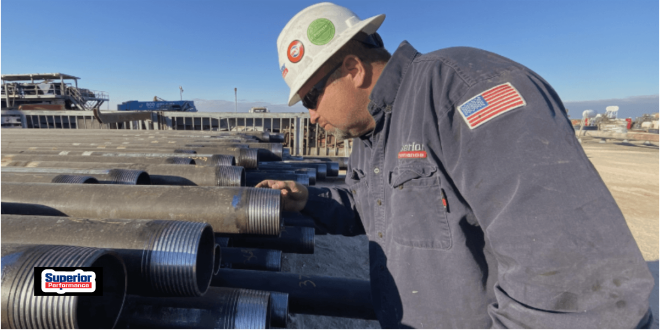
A laser tally is an automated measurement system used in oilfield drilling to accurately measure and track the length of tubulars such as drill pipe, casing, and production tubing. By projecting a laser beam across the pipe, the system captures precise measurements instantly and records them digitally, eliminating manual tally errors and improving operational efficiency at both onshore and offshore drilling sites.
Verify tubular lengths with precision
Reduce manual measurement errors
Track pipe inventory and identification
Improve rig site efficiency
Enhance safety during pipe handling operations
The concept of Laser Tallys emerged from the need to accurately track tubulars during drilling and completion processes. Before its advent, manual tallying was time-consuming and prone to errors.
Imagine the challenges:
Manual Measurement: Crew members physically measuring each tubular using tape measures or other tools. This process was not only slow but also introduced inaccuracies.
Human Error: Recording lengths manually - meaning that human error could creep in—whether due to fatigue, distractions, or simple oversight.
Inventory Challenges: Keeping track of inventory and ensuring seamless operations was a daunting task. Miscounts and discrepancies were common.
A change was imminent.
The LASER, short for “Light Amplification by Stimulated Emission of Radiation,” emerged from decades of scientific observations, ideas and testing.
This included:
(1905) Albert Einstein’s scientific papers on the Photoelectric Effect proposes that light delivers its energy in particles called photons. He also theorized Stimulated Emission, a process crucial for lasers.
(1918/1919) Max Planck: German physicist Max Planck receives the Nobel Prize in physics for his discovery of elementary Energy Quanta.
The development of the laser marked a revolutionary moment in science and technology. From theoretical concepts to practical demonstrations, the journey to the first working laser is a story of innovation, collaboration, and groundbreaking discoveries.
Here's a brief look at the key milestones that led to the birth of lasers:
(1951) American physicist Charles H. Townes conceives the idea of the Maser (Microwave Amplification by Stimulated Emission of Radiation.)
(1960) Charles Townes and Arthur Leonard Schawlow, are granted a U.S. Patent for their theory: Optical Maser (the eventual Laser.)
(1960) The first working laser is demonstrated by American Engineer and Physicist Theodore Maiman using a ruby crystal.
And so, the Laser Era was born.
As lasers began to prove their potential, their impact spread rapidly across various sectors, transforming both technology and medicine. From medical breakthroughs to revolutionary new consumer products, the 1960s through the 1980s witnessed a surge in laser-driven innovations.
Here’s a snapshot of how laser technology quickly became a game-changer in multiple industries:
(1961) Top American technology companies rush to incorporate this new technology into their inventories and business models.
(1961) The first human patient receives Ruby Laser retinal surgery. It was a success!
(1974) A grocery-store laser barcode-scanner scans its first product!
(1984) The United States sees its first commercially released Compact (laser) Disc - Born in the U.S.A by Bruce Springsteen.
Lasers found their place in the oil and gas industry, offering a transformative solution for more efficient oil and gas drilling operations. By the mid-1990s, laser technology was being harnessed to streamline complex tasks, revolutionizing the way offshore and onshore wells were managed.
Here’s how the development of Laser Tallys changed the game in the oil and gas industry:
(1995) Laser Tallys, also known as Automated Pipe Tally Systems, is developed for the industry through a Software Solutions company.
And so, this is how the Laser Tally came into existence and transformed Offshore and Onshore well production, leaving behind the days of manual tallying.
Laser Scanning: A laser beam is projected onto the tubular, precisely measuring its length.
Instant Data: The system instantly captures the measurement data, eliminating the need for manual recording.
Efficiency Boost: With Laser Tallys, rig crews can quickly verify tubular lengths, track inventory, and ensure seamless operations.
Automation and Efficiency: Every joint of pipe arriving at a rig prep facility is measured and racked in a first-in-last-out manner. As a Superior Performance Customer, your records are based on individual SPI numbers, reducing overall manual effort when locating your inventory.
Measurements need not be taken when shipping pipe out of the yard, saving you time and money on every transaction.
The table below compares traditional manual pipe tally methods with modern laser tally systems used in oilfield drilling operations. Laser tally technology improves accuracy, efficiency, and safety when measuring tubulars during drilling and completion operations.
| Feature | Manual Pipe Tally | Laser Tally System |
|---|---|---|
| Measurement Method | Tape measure or manual tools | Laser beam measurement |
| Accuracy | Dependent on human measurement | Highly precise automated readings |
| Speed | Slow and labor intensive | Instant measurement capture |
| Data Recording | Manual logs or paperwork | Digital records and inventory tracking |
| Safety | Workers often climb pipe racks | Measurements taken safely from ground level |
| Operational Efficiency | Prone to delays and errors | Faster verification and workflow |
The Laser Tallys used by Superior Performance, Inc. Field Service Supervisors are non-hazardous Class II rated and pose no threat to workers.
Additionally, Laser Tally utilization eliminates the need for rig personnel to stand on pipe racks to obtain measurements, which makes it a much safer solution.
We invite you to continue the journey with Superior Performance Inc.
A trusted partner in the oil and gas industry, our commitment to excellence aligns perfectly with the precision-driven world of Laser Tallys. Superior Performance offers Laser Tally Services to save our clients’ Rig Time. All SPI Field Service Supervisors are experts in Laser Tally operations.
Ready to elevate your offshore well operations? Reach out to Superior Performance, Inc.:
Phone: 1-800-210-9103
Email: spi.lasertally@superiorperformance.com
Whether you’re onshore or offshore, SPI has the expertise to enhance your drilling experience. Let’s collaborate for superior results!

Superior Performance is a leader in the premium tubular business. Our extensive knowledge of rig operations allows us to prevent problems and offer innovative products to avoid downtime at the rig site. Our offerings include: Multi-Service Provider, Rental Tools, Power Equipment. Other offerings include: thread inspection services, casing I.D caliper and Laser Tally.
At Superior Performance, our team provides drilling contractors and operators with a wide range of construction services to cover most work scopes associated with rig/drilling packages and upgrades, refurbishment, and repair.
1 min read
A Field Service Supervisor is a professional who oversees the work of field service technicians. They are responsible for ensuring that all work is...

1 min read
Have you ever wondered how oil drilling evolved from simple surface oil seeps to the high-tech offshore rigs we see today? The journey of oil and gas...
.png)
1 min read
Field Service Supervisors are critical in oilfield drilling operations because they prevent rig downtime, verify torque and thread integrity,...